René de Baaij
Developing people. Strengthening organisations.I am a coach, counsellor and adviser to executives, teams and organisations that want to grow in how they lead and work together.

- Coaching and counsellingA confidential space for you as the person behind the role. Coaching focuses on your development: what drives you, what holds you back and what you need to lead with more calm and direction. Counselling makes room for what touches you in your work and your life, so that you can choose clearly again.
- Teams and networksWhat matters happens in the space between people. I work with executive teams, teams and networks that want to collaborate better: holding the conversations that are being avoided, making clear agreements and being able to rely on one another again, also across the boundaries of departments and organisations.
- Transformational leadershipTransformational leadership changes not only what people do, but also how they see and what they commit themselves to. It begins with yourself: who you are shapes how you lead. I help you give direction that moves people, challenges them to think for themselves and gives them room to grow, especially when everything is in motion.
- Intelligent organisationsAn intelligent organisation learns from its own experience. It draws on the knowledge and judgement of its people, makes room for reflection and renewal, and connects human and artificial intelligence so that AI strengthens people rather than replaces them. I guide organisations in that development, from the inside out.
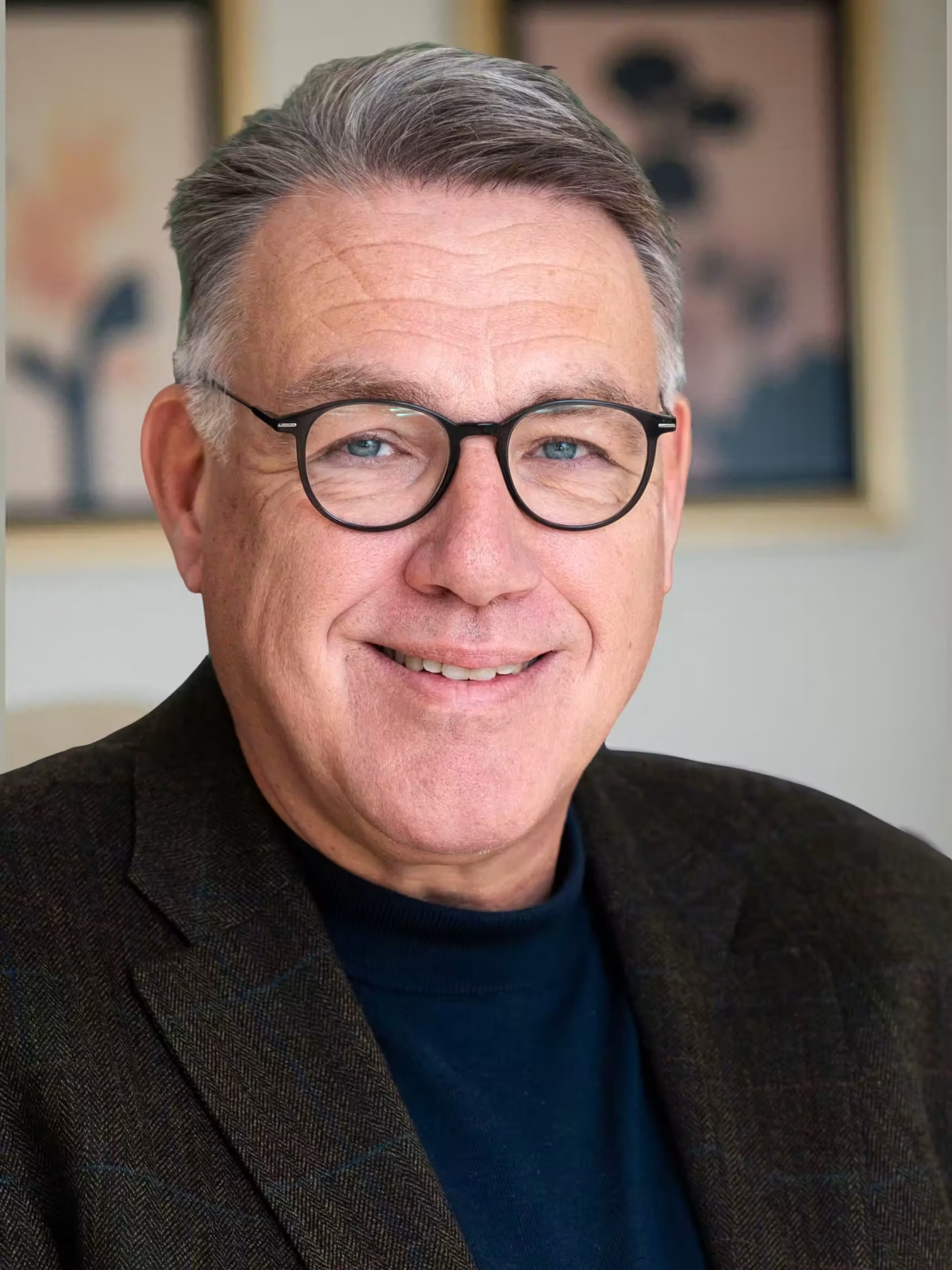
René de Baaij MCM
Bel · Txt · Whatsapp:
+31 (0)6 41 92 42 75
Mail: rene@dbvp.nl
A great deal is coming our way. Geopolitics, climate, society. And AI, which is already changing how we work, decide and collaborate. All of this asks a lot of the resilience of people and organisations.
Meanwhile, you give direction. You choose, take responsibility and deliver results. And you want your people to stay healthy and engaged, and AI to strengthen them rather than replace them.
Much of this succeeds on routine and experience. But some questions keep chafing. How do we work together, with each other and with AI? What does that do to our craftsmanship, our judgement and the way we meet one another?
Such questions call for a pause. For enquiry and reflection, together with the people you work with. That is where learning that lasts begins. That is where the strength of your team and your organisation grows.
That is where I stand beside you. As coach, counsellor and adviser, with extensive experience in leadership, organisational development and the impact of AI. Sometimes as an ally, sometimes as the voice of challenge. I question, mirror and guide, and name what would otherwise remain unspoken. So that you do not merely stay standing, but grow stronger.
René de Baaij
Personal and engaged.
A confidential space for who you are behind the role. You find calm, direction and the courage to choose.
Collaboration as it is meant to be.
Your team holds each other to account again. Decisions are made faster and carried better. Less energy is lost to friction.
Setting people in motion.
Your people take ownership. Change is embraced, not imposed. Your influence reaches beyond your role.
Learning intelligently as an organisation.
Your organisation learns faster than its environment changes. AI delivers gains without losing your people. Renewal that lasts.
Active nationally and internationally, in the public and private sectors, in professional services and industry, in finance and healthcare.
Do you recognise this?
You have set the course, arranged the structure, presented the plans. But if you are honest: you are not sure it truly lands. The conversations that matter still do not take place.
You talk a lot about AI, about acceleration, about the future. And yet the silence grows where it matters most.
You see people who work hard and are loyal. And yet energy is lost to friction and avoidance. Sometimes you need someone to name from the outside what has become invisible from within.
How I work
Every organisational question is ultimately a human question. I do not work on organisations. I work with people. Because change that is not personally felt does not last.
Nothing of value comes about alone. What counts is what happens in the space between people. I stand beside you and together we take on the questions that matter most.
An organisation is more than a structure. I work with organisations as living systems, not to optimise them, but to bring them to themselves.
What clients say
"Sharp on the substance, but above all on what we ourselves were avoiding."
Director, public sector"He is present at the moments that count. Not with advice, but with the question you did not dare to ask yourself."
CIO, financial sector"What sat under the table came onto the table. And suddenly we could choose."
COO, industry
What I can offer
You regain calm and perspective. You choose more deliberately. You lead from who you are, not on autopilot.
You regain trust and direction. You speak openly with one another. You work together from a shared purpose, not from separate islands.
You regain energy and momentum. Your people take responsibility themselves. You lead by giving direction, not by controlling.
You regain grip and agility. Your organisation learns faster. You use AI to support human judgement, not to replace it.
Situations you may recognise
Public sector
- Situation An executive team divided on course that increasingly held back from challenging one another.
- Intervention Guidance in the avoided conversations. Clear mandate, explicit ground rules.
- Result Fewer meetings, better decisions. A team that challenges one another again.
Financial sector
- Situation A board that had set up AI governance but found the organisation disengaging.
- Intervention Surface and undercurrent connected. Governance design adjusted so that learning becomes possible.
- Result More ownership at every level. Governance as a workable framework.
Industry
- Situation After a reorganisation, managers were hesitant and waiting.
- Intervention The managers' own development placed at the centre.
- Result A management team that looks ahead again. The organisation followed.
Professional services
- Situation Self-managing teams turned out not to be self-managing in practice.
- Intervention Professional identity and self-worth strengthened.
- Result Teams that function independently as intended. More enjoyment in the work.
Recent thinking
I write regularly about leadership, organisation and the impact of AI on people and work. No newsletter, no noise, only pieces that are about something.
uātēs the art of leadership
As initiator and founder I take part in uātēs, a collaboration of experienced organisational professionals focused on leadership and organisational development. uātēs works from the conviction that leadership is a craft that calls for continual deepening.
The name uātēs refers to the ancient poet-seer: the one who speaks what others see but do not say. That is the heart of leadership, and the heart of our collaboration.
From uātēs we developed uātēs Lux, an AI-driven conversation partner for leaders and organisational professionals. Not a generic chatbot, but a considered partner that thinks from the complexity of real work.